British-Egyptian dissident appears to endorse ‘smear campaign’ claims
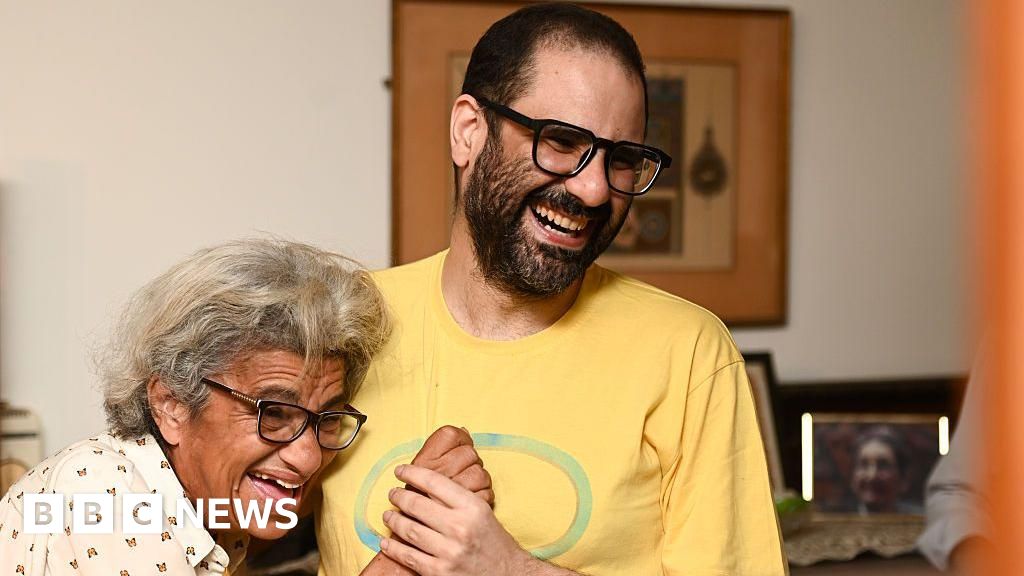
The British-Egyptian activist at the centre of a political row appears to have endorsed new and baseless claims that he is the victim of a “smear campaign”.
Alaa Abd El Fattah flew to the UK on Friday to be reunited with his family for the first time in 12 years following his release from an Egyptian jail where human rights groups said he had been unfairly detained.
The prime minister welcomed his return in a post on X but subsequently faced criticism after old social media posts emerged in which Mr Abd El-Fattah called for the killing of Zionists and police officers.
Sir Keir Starmer has since said he was unaware of the “absolutely abhorrent” resurfaced posts, which Mr Abd El Fattah has apologised for, and said the government was “taking steps to review the information failures in this case”.
“With the rise of antisemitism, and recent horrific attacks, I know this has added to the distress of many in the Jewish community in the UK,” he added.
Foreign Secretary Yvette Cooper has asked a senior civil servant to review why ministers in the current and former governments were not aware of Mr Abd El Fattah’s previous comments.
Mr Abd El Fattah’s apology, which came in a statement issued in the early hours of Monday morning, said that he understood “how shocking and hurtful” the posts were.
He said the comments were “expressions of a young man’s anger”.
The apology was welcomed by the prime minister’s spokesman on Monday. He said it was a “fairly fulsome apology and that’s clearly the right thing to do”.
However, within hours of his apology, BBC News has established that Mr Abd El Fattah’s Facebook account liked another user’s post which described criticism of him as a “relentless smear campaign” being waged by “the richest man in the world, a couple of Middle East intelligence services, and a few Zionist organisations”.
Shadow justice secretary Robert Jenrick has highlighted a second posted liked by Mr Abd El Fattah’s Facebook account on the same day which claimed he was a victim of a campaign by Zionists. BBC News has seen a screenshot of this second message but the original post appears to have been deleted.
Jenrick said the two posts “show El Fattah’s apology was insincere and scripted”.
“Far from distancing himself from his earlier extremist views, he confirms that he still holds them. Far from showing contrition, he is presenting himself as the victim of a conspiracy,” he added.
He said the posts “suggest the threshold for revoking his citizenship could be met: he was, and remains, a threat to national security, and his presence in the UK is clearly not conducive to the public good”.
The Facebook account belonging to Abd El Fattah had previously shared a photo of him being reunited with his 14-year-old son Khaled on his arrival in the UK.
The activist, who has spent more than a decade behind bars, rose to prominence during the 2011 uprising that forced then-Egyptian president Hosni Mubarak to resign.
In 2021 he was convicted of “spreading fake news” for sharing a Facebook post about torture, in a trial that was widely condemned as unfair by human rights groups.
He was granted British citizenship in December 2021, while the Conservatives were in power, and was eligible through his London-born mother.
Since his old tweets emerged, the Conservatives and Reform UK have called for the government to strip him of his British citizenship and deport him.
Although the home secretary has powers to strip a dual national of their citizenship if it is deemed not to be “conducive to the public good”, in practice this has typically been used in cases linked to terrorism or serious organised crime where someone is deemed a national security threat.
It is understood that Downing Street believes that this high bar is not met in this case. Any decision to strip someone of their citizenship is also likely to face a potentially lengthy and expensive legal challenge.
The activist had been withdrawn as a nominee for a human rights prize a decade ago over comments he made online about Israel he had posted in 2012.
Rail minister Lord Hendy said it was right the government was looking into why ministers were unaware of the messages.
“What he said was clearly quite abhorrent. Nobody would subscribe to that – certainly not the government. And now there is an inquiry by the Foreign Office about how these tweets were overlooked,” he said.
Published at Tue, 30 Dec 2025 16:12:05 +0000